Partner
Safety and comfort
Weighs reliability, interior space and running costs. Can veto models seen as risky or uncomfortable.
A conceptual model developed by Marc Perelló-Sobrepere in ¿Me lo compro? (Libros de Cabecera, 2026) to analyse how the people around a consumer can validate, question, modify or hold back a purchase. Even when they do not buy the brand themselves, they influence whether a choice feels credible, appropriate and defensible.
The model complements the buyer persona rather than replacing it: the profile defines the consumer, and the Stadium adds their social environment.
Download the teaching kit (ZIP)

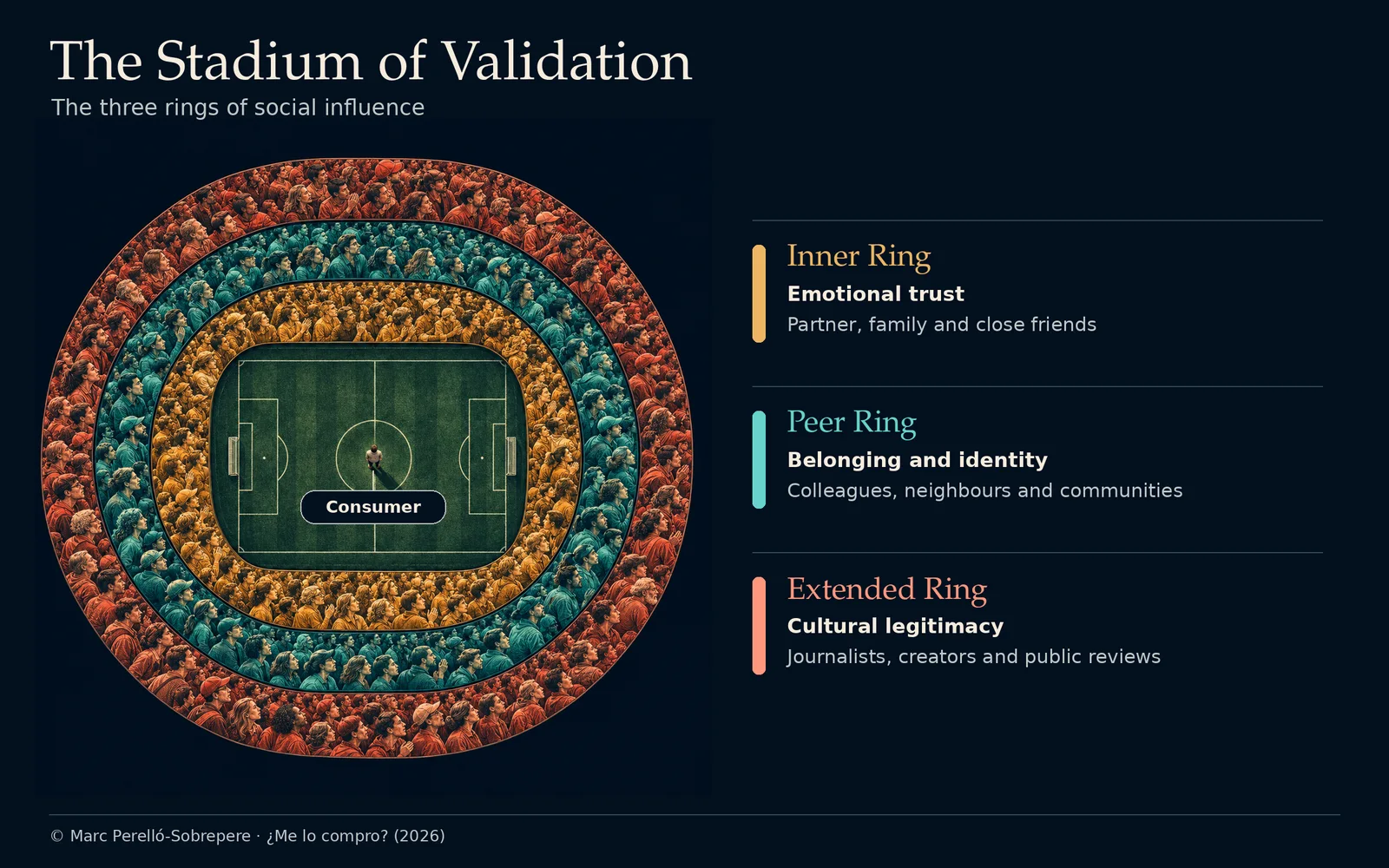
The consumer stands on the pitch and the stands hold the people who can influence their decisions. It is a map for analysis, not a sequence of stages or a scoring algorithm: the three rings distinguish social relationships and modes of influence, and they can come into play in any order.
Lower stand
Family, partners, children and best friends. Their opinion carries weight because of closeness and trust, not necessarily technical knowledge. They can reassure, object to or veto a choice.
Strategic question: Can the buyer comfortably explain the decision to the people closest to them?
Middle stand
Colleagues, acquaintances, neighbours, communities and tribes. They share cultural references and expectations, and shape what a choice says about identity, status and belonging.
Strategic question: Does the brand fit the groups that matter to the consumer?
Upper stand
Opinion leaders, journalists, celebrities, content creators and public reviews. They provide reputational signals and frames of aspiration or comparison, often with no direct personal relationship.
Strategic question: Which public narratives legitimise or question the brand?
Before
Cultural references, conversations and repeated exposure decide which options feel familiar even before someone starts looking for a product.
During
Questions, recommendations, anticipated reactions and group negotiation can validate or block a choice while alternatives are compared.
After
The purchase is used, shown, discussed and re-evaluated. Approval, criticism and experience become references for later decisions, one's own and other people's.
The three rings can reinforce one another or clash. Interest created by public visibility can be stopped by a partner's objection; identification with a group can be weakened by negative expert reviews. When a campaign generates attention but not purchases, it is worth investigating which environment is resisting, and what evidence supports that hypothesis.
A useful output: a map of validators, objections, opportunities and open questions for each ring.
Teaching scenarios built to explain the model. Their hypotheses do not replace consumer interviews or real campaign results.
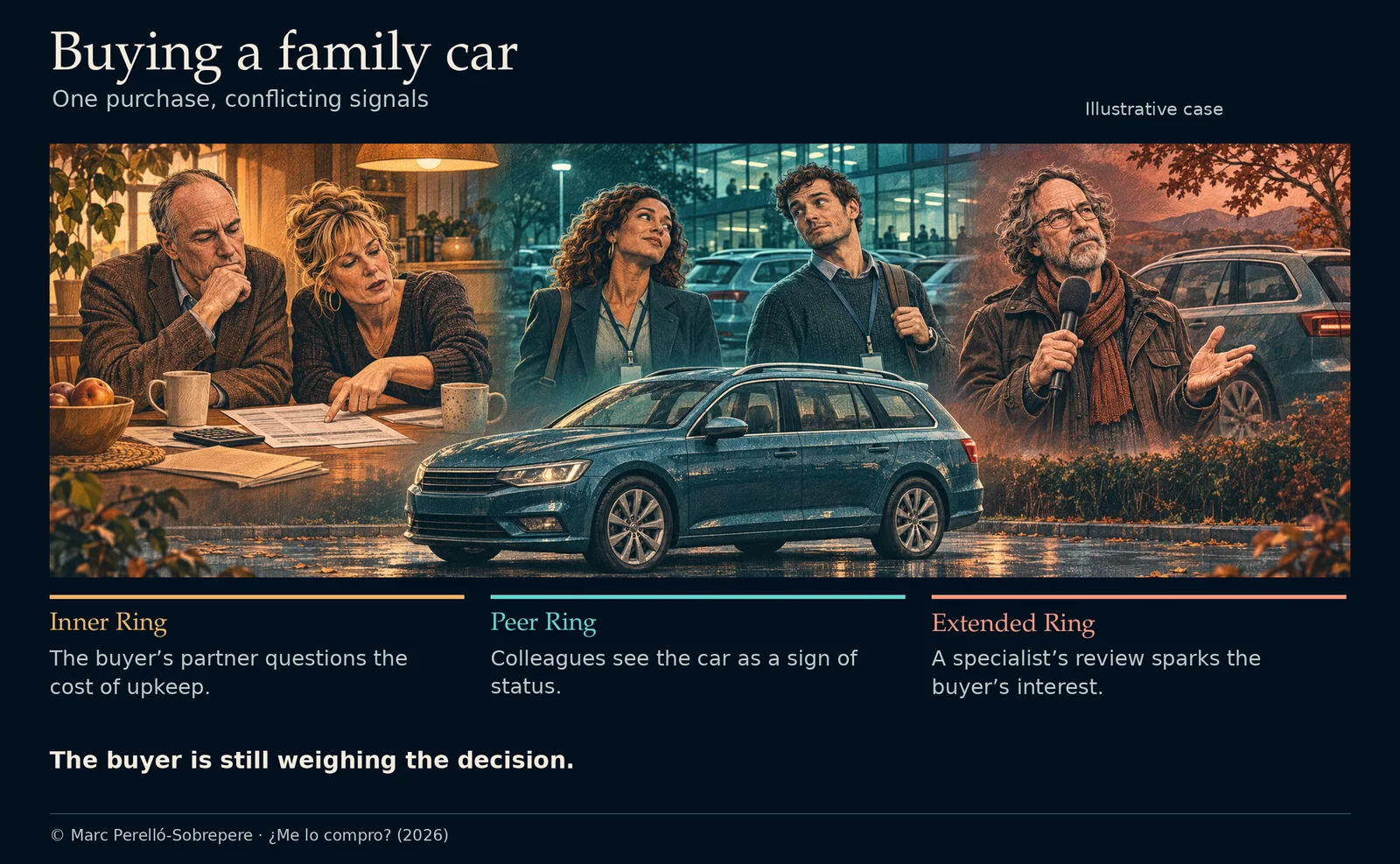
Partner
Weighs reliability, interior space and running costs. Can veto models seen as risky or uncomfortable.
Children
They shape the format: family SUV or saloon. Their presence turns the purchase into a collective decision, not an individual one.
Close friends
Their view of a brand or model outweighs any review. “I had one and it was a disaster” ends the conversation.
Work colleagues
The car is parked at work every day. The brand speaks before the driver says anything, especially in competitive professional settings.
Neighbours and community
The car is seen parked every morning. It works as a constant signal of position in the closest, most repeated environment.
Brand lovers
Owners' groups, brand clubs and model forums build identity and loyalty that conventional advertising struggles to reach.
Motoring journalists
Outlets such as Top Gear set the comparative frame. Their verdicts legitimise a model even if the buyer never reads them directly.
Celebrities
They don't explain the engine: they show how the car fits the life the buyer wants to project. Brand attributes outweigh technical ones.
Reviews and forums
Google Maps, Trustpilot, specialist forums. A positive pattern speeds up the purchase; a negative one rules it out for good.
© Marc Perelló-Sobrepere · Adapted from ¿Me lo compro? (Libros de Cabecera, 2026)
| Ring · actor | Validation or resistance | Possible communication response |
|---|---|---|
| Trust · partner, children, close friends | The partner weighs safety, comfort and maintenance; children shape space needs; friends contribute first-hand experience. | Verifiable running costs, safety, test drives and family-use trials. |
| Belonging · colleagues, neighbours, owners' clubs | The car communicates social position; user communities create identity and shared codes. | Owner testimonials, after-sales service and positioning adapted to context. |
| Reference · specialist press, celebrities and forums | The press provides comparative authority; celebrities add aspiration; reviews and forums affect perceived risk. | Verifiable specifications, independent comparisons and credible public conversation. |
Possible blocker: Aspiration sparks interest, but the partner vetoes on reliability or price.
How to test it: Pin down the objection, show total cost of ownership and gather real usage experiences.
On Saturday a family tries a new box. The person doing the shopping is happy with the price, and a recommendation from the school parents’ group encouraged them to pick it up. At breakfast, their partner looks at the ingredients and their child leaves the bowl half-eaten. The decision is made again the following week, in front of the shelf.
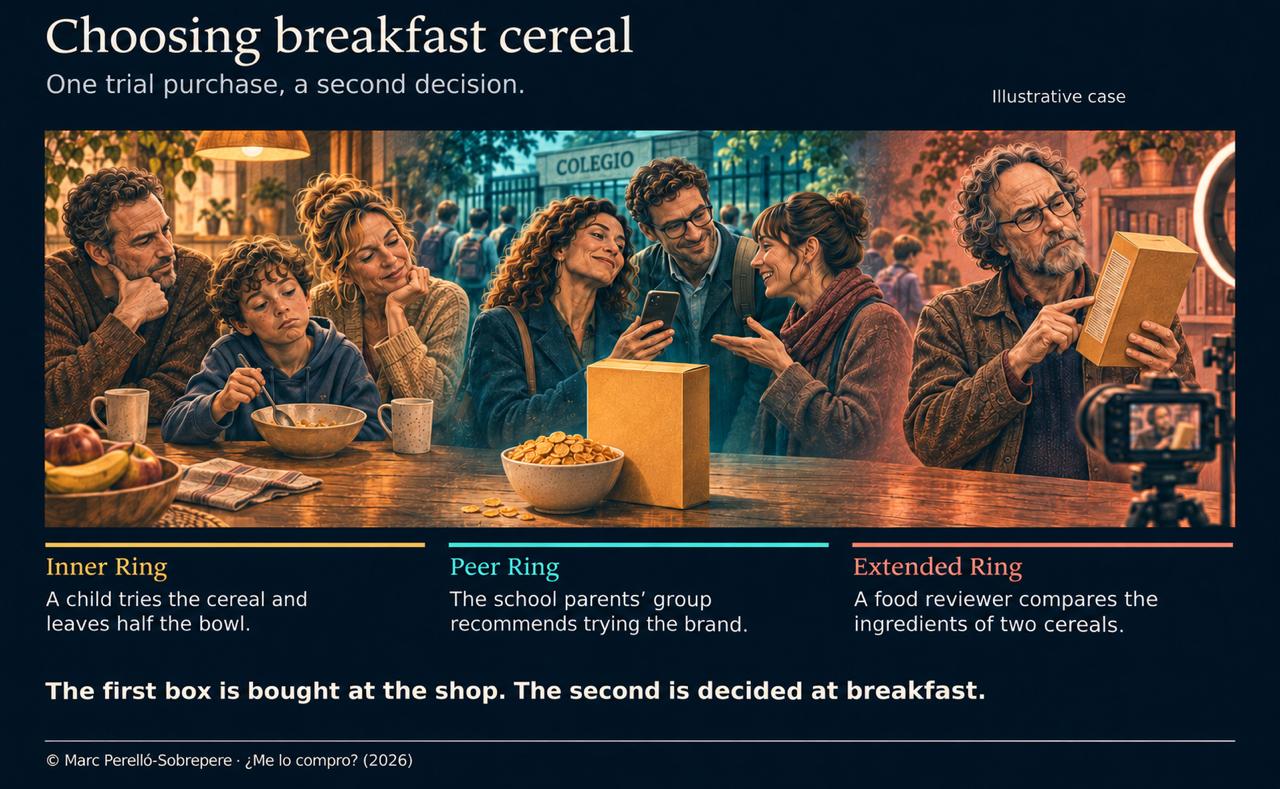
Partner
Compares the ingredients and the price per kilo with the usual box. If the difference does not seem worth it, they will ask to go back to the old one.
Children
Taste and texture weigh heavily on whether the box is bought again. A half-eaten bowl can stop the next purchase.
Grandparents who look after the children
They know which breakfasts work when the children stay with them. Their experience can settle a doubt or predict that the box will end up unopened.
School parents
The group chat shares brands that work at home and doubts other families have too. A recommendation turns an unknown box into an option worth trying.
Colleagues
In a conversation about the shopping basket, someone mentions that a supermarket own brand works just as well for them. The group shifts what seems reasonable to pay.
Home-breakfast community
In a group that shares simple breakfasts, seeing how others combine the cereal with fruit or yoghurt helps them picture it in their own routine.
Food communicators
A comparison explains how to read ingredients and values per 100 g. It can spark interest or reveal a difference the front of the box did not make clear.
Consumer media and organisations
A basket comparison or a published test makes it possible to tell the price per box from the price per kilo.
Public reviews
If several people say the cereal goes soggy quickly, that observation can stop a trial in a home where texture matters.
© Marc Perelló-Sobrepere · Adapted from ¿Me lo compro? (Libros de Cabecera, 2026)
| Ring · actor | Validation or resistance | Possible communication response |
|---|---|---|
| Trust · Partner, children and grandparents | Price and ingredients justify a trial, but taste or texture can prevent a repeat purchase. | Offer a small trial size and show the ingredients, the price per kilo and the pack size clearly. |
| Belonging · School parents, colleagues and breakfast community | Recommendations reduce the initial doubt, and other households’ habits change what counts as a reasonable purchase. | Create an easy-to-share sheet with the price per kilo and simple ways to serve the product, based on real questions from families. |
| Reference · Food communicators, consumer media and reviews | Comparisons and reviews put the focus on ingredients, price and texture. | Publish the current label with values per 100 g and answer frequent questions about the product with verifiable information. |
Possible blocker: The school group encourages buying the box, but the child does not want it again and the partner asks for the usual brand.
How to test it: Run a breakfast test at home and ask each person separately what prompted the first purchase and what would make them want it again.
Someone finds a hotel for a two-night city break. The room wins them over and their travel group recommends the neighbourhood. Their partner opens the map and asks a question that stops the booking: “If we get back late from dinner, how do we get to the hotel?” The conversation moves from the room photos to the journey back.
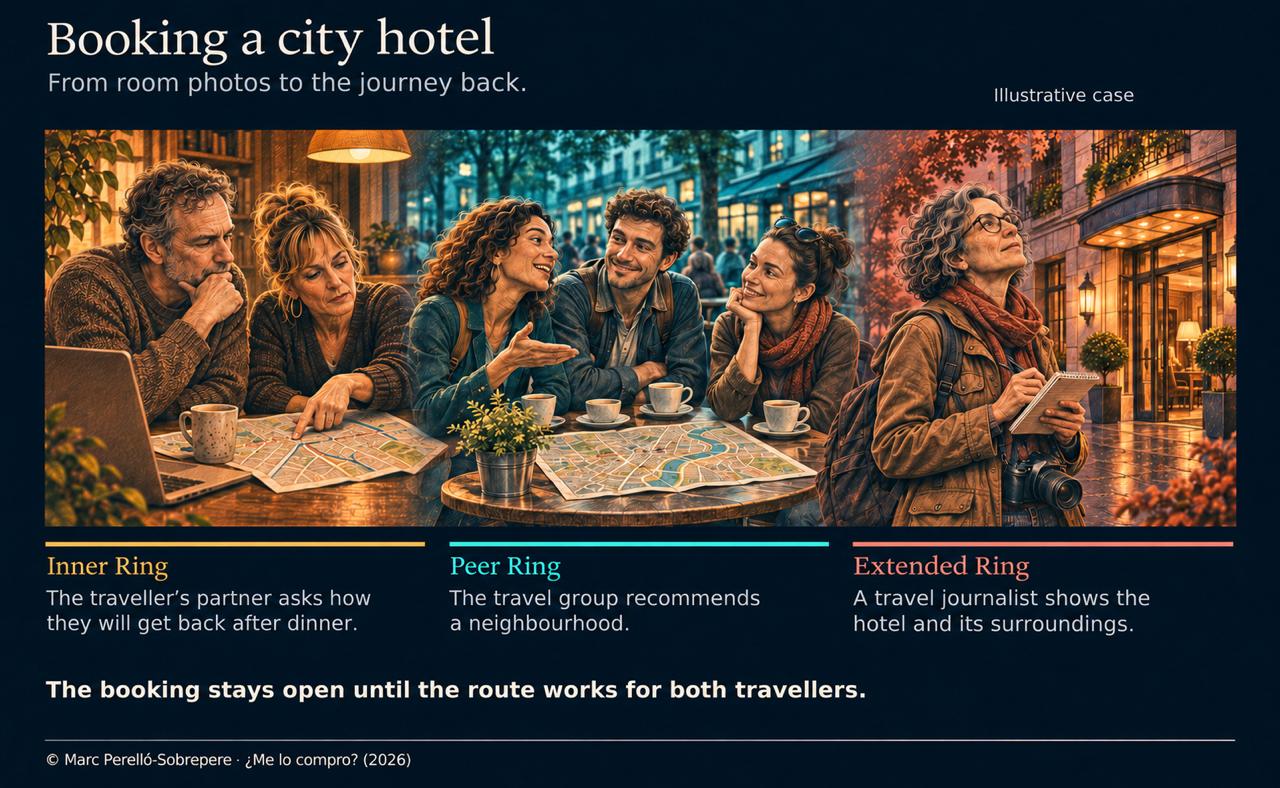
Partner
Checks the route from the restaurant, the connections and the time they will get back. Can stop the booking even if they like the room.
Close friend who has stayed there
Describes what arriving late was like and how much noise you could really hear. Their account settles doubts that an average rating leaves open.
Relative who knows the city
Suggests a different stop or explains which route is easier with luggage. Their advice carries weight because of personal trust and because they know the travellers’ needs.
Regular travel group
Members share views on what is worth paying for and whether they prefer to walk from the hotel or use public transport.
Rail travel community
The group shares tried-and-tested routes from the station and spots changes that go unnoticed when you only look at the distance on the map.
Cultural outings community
People who share museum and restaurant routes help decide whether the hotel is close to the plans they will actually make.
Travel journalists and guides
They explain what there is to do in the area and how it connects with the rest of the city. Their coverage can put the hotel or the neighbourhood on the radar.
Travel creators
A walk-through from the street to the room gives a sense of the entrance, the access and the space.
Public guest reviews
Several recent mentions of noise, late arrival or reception help tell a one-off incident from a question worth clearing up.
© Marc Perelló-Sobrepere · Adapted from ¿Me lo compro? (Libros de Cabecera, 2026)
| Ring · actor | Validation or resistance | Possible communication response |
|---|---|---|
| Trust · Partner, close friend and relative | The room is appealing, but the travel companion questions the journey back and listens to people who know the destination. | Show the route from the usual points, the transport options and the late-arrival procedure, based on the hotel’s real conditions. |
| Belonging · Travel group and travel and culture communities | Groups influence which neighbourhood is seen as a good base and how much travel is acceptable. | Offer a shareable map with routes from the station and points of interest, with approximate times and the means of transport. |
| Reference · Guides, creators and reviews | Coverage sparks interest, and public accounts pin down doubts about noise, access or arrival. | Use accurate photos of the rooms and the entrance, explain arrival conditions and answer recurring questions with specific information. |
Possible blocker: The neighbourhood recommendation and the photos lead to starting the booking, but the partner stops it when there is no clear way back after dinner.
How to test it: Review pre-booking questions and interview people who abandoned the process. Ask at what point the doubt arose and what information would have helped them decide.
A professional sees a navy blazer in a creator’s video that looks easy to wear with anything. She tries it on and pictures herself wearing it to her next client meeting. Her friend, who knows her wardrobe well, asks what she would wear it with on an ordinary Tuesday. The purchase takes on a new meaning when she stops imagining a special occasion and thinks about her real week.
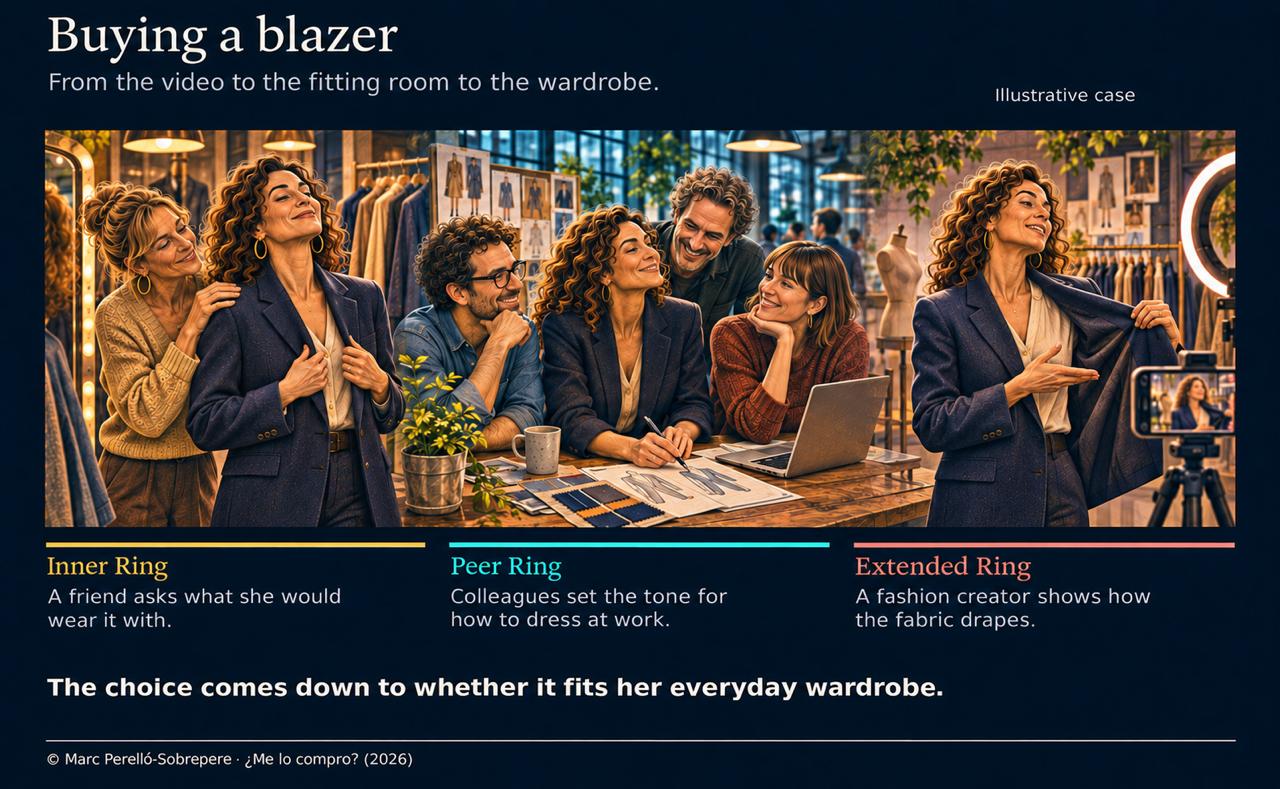
Close friend
Knows what the buyer actually wears. Can suggest a specific combination or remind her that a similar jacket ended up unworn in the wardrobe.
Partner
When the price comes up, asks on which occasions she plans to wear it. The conversation turns an abstract expense into a question about real use.
Sister
If she comes to the fitting room, she can help check how it looks from behind and whether it pulls at the shoulders when she crosses her arms.
Colleagues
How they dress gives clues about when a blazer suits a meeting and how to wear one without feeling out of place.
Regular group of friends
Dinners, exhibitions and other shared plans provide concrete occasions to judge whether the blazer also works at the weekend.
Second-hand fashion community
The group shares outfits and second-hand finds. Its criteria can lead her to reconsider the price of a new piece or to look for a different cut.
Fashion creators
A video shows how the fabric moves and what changes when the blazer is worn with jeans or with tailored trousers.
Media and stylists
They help explain the effect of a structured shoulder or a relaxed silhouette and whether it fits the style she is after.
Public reviews from buyers
Comments that mention usual size, build and fit help anticipate problems that the catalogue photo leaves open.
© Marc Perelló-Sobrepere · Adapted from ¿Me lo compro? (Libros de Cabecera, 2026)
| Ring · actor | Validation or resistance | Possible communication response |
|---|---|---|
| Trust · Close friend, partner and sister | She likes the blazer in the fitting room, but the people closest to her bring doubts about comfort, frequency of use and combinations to the surface. | Show the blazer in motion and with everyday clothes such as jeans, a T-shirt and tailored trousers. Give the garment’s measurements and clear exchange conditions. |
| Belonging · Colleagues, group of friends and second-hand community | Each group contributes criteria about formality, occasions and what is worth buying new. | Show people wearing the same blazer in specific office, leisure and weekend settings. Create an easy-to-share sheet with those combinations. |
| Reference · Creators, media and reviews | Public content sparks interest and makes it possible to compare cut, drape and sizing before trying it on. | Show the size and measurements of the people photographed, include a video of the blazer in motion and make reviews with fit information easy to find. |
Possible blocker: The video inspires the purchase, but the buyer cannot find enough occasions or combinations to justify it.
How to test it: After the try-on, ask what people would wear it with and on which occasions. Separately review reasons for abandoning or returning it related to sizing, comfort and intended use.
Each kit includes the teaching guide and the classroom slides (PDF, Word and PowerPoint), a printable worksheet and the model illustrations. The guide has a printable student worksheet (20–35 minutes).
Download the teaching kit (ZIP)
Research documents the importance of interpersonal recommendations, brand trust and social identity in consumption. This is the empirical basis of the problem the Stadium of Validation addresses. Percentages depend on each study's questions and populations.
88 %
Nielsen · Trust in Advertising (2021)
Respondents named recommendations from people they know as the channel they trust most (56 countries).
Measures stated trust in a channel, not the share of purchases caused by recommendations.
View study20–50 %
McKinsey · A new way to measure word-of-mouth marketing (2010)
Word of mouth was the primary factor in 20% to 50% of purchase decisions, especially for products that are new to the consumer or relatively expensive.
A historical estimate, not a current universal rate.
View study88 %
Edelman · Brand Trust, From We to Me (2025)
Across 15 markets, 88% say trusting a brand is important or a deal-breaker, on a par with quality and value for money.
Measures trust in brands, not the influence of family or friends.
View study~6/10
Edelman · Brands and Politics (2024)
Around six in ten Gen Z and millennial respondents feel connected to other people who use the same brands.
A sign of consumption as a marker of social identity.
View study53 %
Edelman · Brands and Politics (2024)
Across 14 markets, 53% are more likely to recommend a brand they fully trust than one they do not.
Links trust to recommendation, not to measured conversion.
View studySocial influence can be observed and measured, but who validates a specific purchase has to be investigated case by case. The Stadium offers a structured qualitative map for doing so.